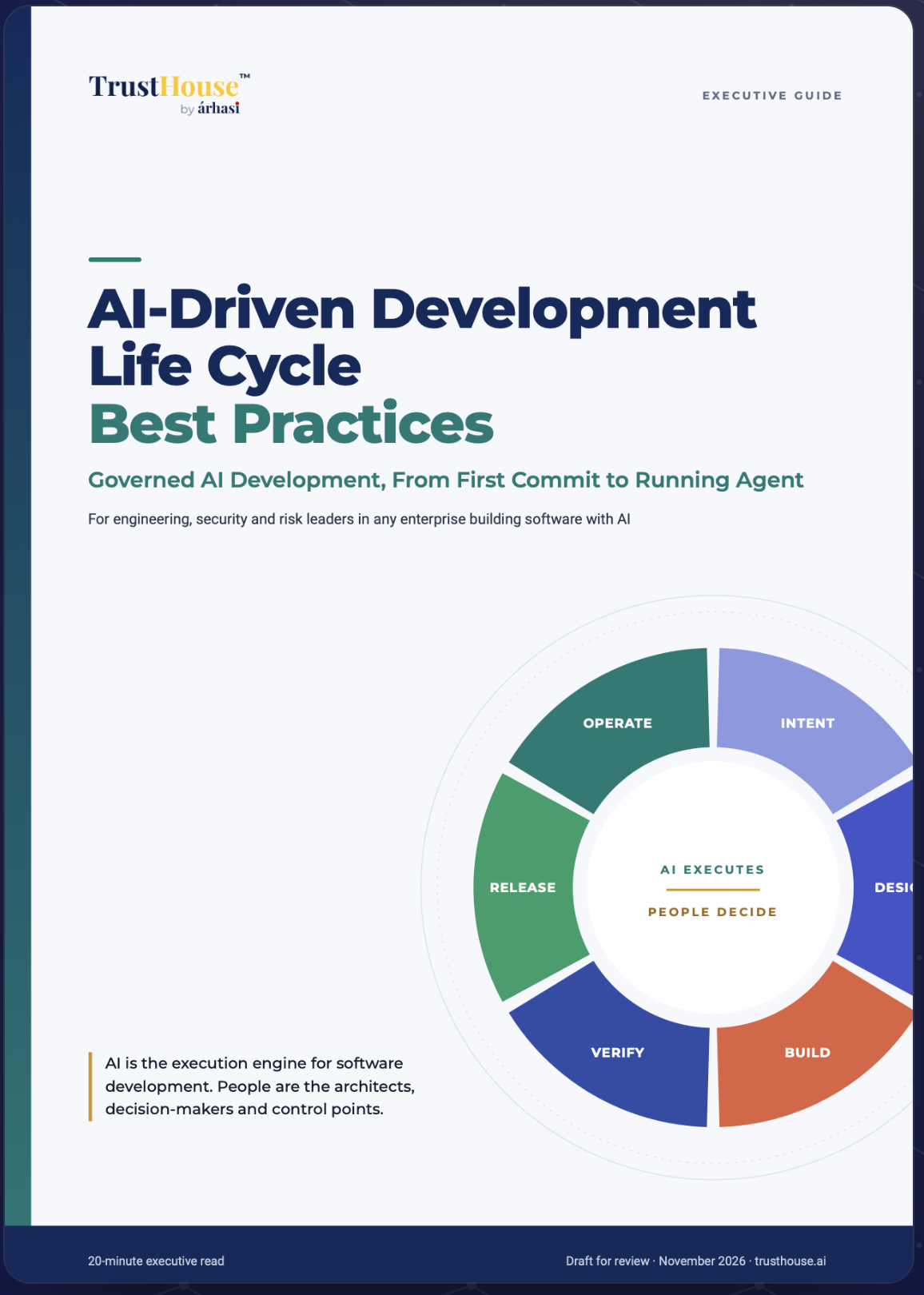

New AI-DLC guidance addresses security, compliance oversight, human approvals, and accountability as organizations accelerate AI-assisted software development.
FRISCO, TX, UNITED STATES, November 24, 2026 /EINPresswire.com/ — As organizations increasingly adopt AI coding assistants, autonomous development agents, and conversational programming tools, the traditional software development lifecycle is undergoing a fundamental shift. While these technologies can accelerate application development, they also introduce new questions around code quality, security oversight, accountability, traceability, and regulatory compliance.
TrustHouse.AI is highlighting the importance of governing the entire AI Development Lifecycle (AI-DLC), bringing security, compliance, and engineering governance into the development process rather than treating them as final checkpoints before production.
The growing adoption of AI-assisted development and so-called “vibe coding” has made it easier for developers and business teams to generate applications, automate workflows, and build software with minimal traditional coding. However, the speed of development also makes it increasingly important for enterprises to establish clear controls over how applications are designed, generated, validated, approved, and deployed.
Traditional software development governance practices were largely designed around human-authored code and established engineering workflows. AI-driven development introduces additional considerations, including AI-generated requirements, code generation, agent-assisted changes, automated testing, and human oversight of AI-generated outputs.
##Governing Development Without Slowing Innovation
The AI Development Lifecycle governance approach emphasizes embedding structured checkpoints throughout the software development process.
##Key areas of consideration include:
Requirements Governance: Establishing traceability between business requirements, AI-generated specifications, development tasks, and acceptance criteria.
**Development Controls: Defining appropriate policies and oversight for AI-generated code, developer-assisted applications, and autonomous development agents.
**Security Gates: Incorporating security reviews, vulnerability assessments, and policy validation throughout development.
**Testing and Validation: Ensuring AI-generated outputs undergo appropriate functional, quality, and security testing before approval.
**Human-in-the-Loop Approvals: Establishing clear responsibility for reviewing and approving AI-generated artifacts and consequential development decisions.
**Deployment Governance: Applying release authorization, auditability, and traceability before applications reach production.
**Continuous Accountability: Maintaining visibility into development activities, approvals, changes, and supporting evidence.
These controls are intended to help organizations establish a consistent governance approach without unnecessarily restricting developer productivity or experimentation.
##From AI-Assisted Development to Enterprise-Ready Software
“The objective should not be to slow down AI-driven development. It should be to make the development lifecycle more accountable, observable, and governed,” said Chiru Bhavansikar, Chief AI Officer at TrustHouse.AI.
“Developers should be empowered to use AI to build faster, while security and compliance teams should have appropriate visibility, defined approval responsibilities, and enforceable controls. Enterprise leadership needs confidence not just in what is being built, but also in how it was built and validated.”
TrustHouse.AI advocates an approach in which governance is integrated into the development lifecycle, rather than added retrospectively after applications have already been created.
This approach also recognizes that governance responsibilities are shared. Developers remain responsible for engineering quality, security teams establish and oversee security requirements, compliance teams define applicable obligations, and organizational leadership establishes accountability.
A Framework for the Next Generation of Software Development
As AI becomes an increasingly integrated part of software engineering, organizations will need to evolve their development governance practices accordingly.
The AI Development Lifecycle provides an opportunity to bring engineering discipline, security oversight, human accountability, and traceability into AI-assisted software creation.
TrustHouse.AI’s position is straightforward: AI should accelerate software innovation, while governance ensures that innovation can be responsibly adopted and operated at enterprise scale.
For more information, visit https://trusthouse.ai/resources/ai-dlc-guide
Chiru Bhavansikar
TrustHouse.AI (dba Arhasi Inc)
+1 214-302-7147
Visit us on social media:
LinkedIn
YouTube
Legal Disclaimer:
EIN Presswire provides this news content “as is” without warranty of any kind. We do not accept any responsibility or liability
for the accuracy, content, images, videos, licenses, completeness, legality, or reliability of the information contained in this
article. If you have any complaints or copyright issues related to this article, kindly contact the author above.

Media gallery