
Key Takeaways
- Fall webworms and tent caterpillars are different insects that appear at opposite ends of the year, one in late summer and fall, the other in early spring.
- Fall webworms web the ends of branches, while tent caterpillars build dense tents in the crotches where branches meet.
- On healthy, established trees the damage is mostly aesthetic, and many infestations can be left to nature.
- Young, newly planted, stressed, or repeatedly defoliated trees carry the real risk and may warrant treatment.
- Integrated pest management blends monitoring, cultural controls, biological options such as Btk, and targeted chemical sprays when needed.
Silk in the canopy sets off alarm for many Houston property owners, but the two usual causes behave quite differently. A clear overview of fall webworms and tent caterpillars shows that one species feeds in late summer and fall while the other arrives in early spring, and each leaves a different signature on the branch.
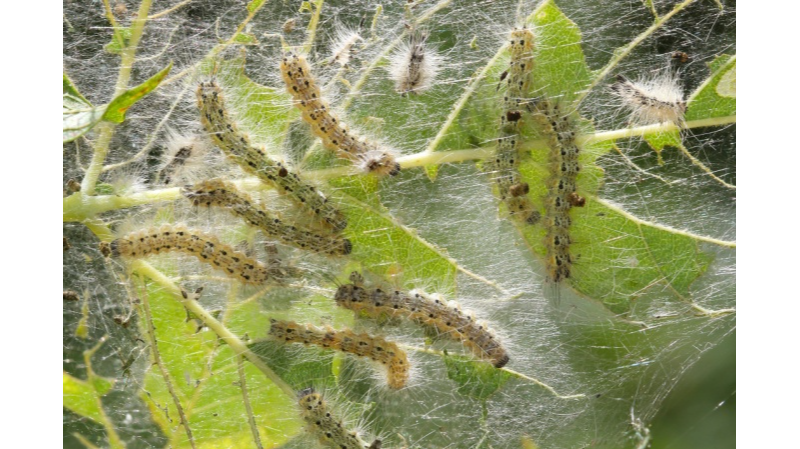
How to Tell Them Apart Fall webworms (Hyphantria cunea) build loose silk nests at the ends of branches from late summer into fall, most commonly in Houston between August and October. The caterpillars are pale yellow to grey with long, fine hairs, and they feed inside the expanding web where predators cannot easily reach them. Tent caterpillars (Malacosoma species) appear at the opposite end of the year. They build dense silken tents in the crotches where branches meet, hatch from eggs that overwinter on branches, and leave the tent each day to feed before returning for shelter.
What They Feed On Fall webworms are generalists that feed on more than 250 tree species, including pecan, mulberry, elm, sweetgum, sycamore, and many fruit trees. Tent caterpillars prefer the rose family, which includes plum, cherry, apple, and ornamental fruit trees. Heavy tent caterpillar feeding can rapidly defoliate small ornamental trees in spring.
Life Cycle and Timing Fall webworms overwinter as pupae in the soil, and the adults emerge in mid-summer to lay eggs on the undersides of leaves. Tent caterpillars overwinter as egg masses on twigs, where the masses stay visible year-round, and the larvae hatch as leaf buds break. Because early-stage colonies are far easier to control than mature ones, knowing which insect is present, and when it is active, guides every treatment decision.
How Much Damage They Really Cause On established, healthy trees, the damage from either insect is mostly cosmetic, and trees usually refoliate. Repeated late-season defoliation can draw down the energy reserves a tree carries into dormancy, and spring defoliation tends to be harder on a tree than late-season feeding. The greatest risk falls on young, newly planted, or already stressed trees, and on any tree facing repeated defoliation year after year. Consistent tree maintenance and ongoing tree care helps vulnerable trees stay vigorous enough to shrug off seasonal feeding.
An Integrated Pest Management Approach Effective management often starts with monitoring and letting nature take its course. Early spring inspections can catch tent caterpillar egg masses, and summer scans of branch tips can catch early fall webworm webs while colonies are small and easier to manage. On healthy trees, natural predators such as paper wasps, yellowjackets, birds, and parasitic flies and wasps often keep populations in check. A small, low nest can be removed by hand, and visible tent caterpillar egg masses can be cleared during the dormant season. When an infestation is severe enough to justify action, Bacillus thuringiensis kurstaki (Btk) is effective on early instar caterpillars and, like any product, should be applied strictly according to its label. For heavier infestations, an appropriately labeled chemical spray may be recommended, with options that include systemic injections for high-value shade trees, contact sprays labeled for caterpillar control, and targeted applications directly into the webs early in the infestation. Timing is the key variable, because early-season treatment delivers the greatest impact.
When to Call a Professional One rule holds in every case: webs should never be burned out of a tree. Burning causes far more harm to the tree than the caterpillars ever would, and it is a serious fire hazard. When a nest is too high to reach safely or an infestation is heavy, a professional assessment is the safer route. Houston property owners who want help identifying or treating webbing and defoliation can schedule an evaluation with Tree Care Inc., serving Greater Houston, Washington County, and the Hwy 290 Corridor since 1979.
Tree Care, Inc.
1 713-850-8466
106 South Market Street
Brenham
Texas
77833
United States


