eIDAS 2.0 and Cloud-Based Authentication Accelerate Market Adoption
ROCKVILLE, MD, UNITED STATES, April 21, 2026 /EINPresswire.com/ — According to the latest market analysis by Fact.MR, the Germany Biometric-as-a-Service (BaaS) market is undergoing a profound transformation. Valued as a critical pillar of the broader USD 4.2 billion global sector in 2025, the German market is estimated to expand significantly through 2026, reaching a projected CAGR of 18.4% during the forecast period (2026–2036).
The market is shifting from legacy on-premises hardware toward scalable, API-driven cloud platforms. This evolution is catalyzed by the European eIDAS 2.0 mandate, which requires EU member states to provide secure Digital Identity Wallets. In Germany, the Federal Office for Information Security (BSI) guidelines, specifically BSI TR-03159, are now the gold standard, defining the liveness detection and verification requirements that vendors must meet to qualify for high-stakes government and financial contracts.
Get detailed market forecasts, competitive benchmarking, and pricing trends:
https://www.factmr.com/connectus/sample?flag=S&rep_id=14524
Quick Stats: Biometric-as-a-Service (Germany Focus)
Metric
Details
Market Valuation (Global 2025)
USD 4.2 Billion
Projected CAGR (Germany)
18.4%
Leading Segment (Scanner)
Fingerprint Recognition (32% Share)
Leading Deployment Model
Hybrid Cloud (24% Share)
Growth Catalyst
eIDAS 2.0 & EU Digital Identity Wallet
Key German/EU Players
Thales, IDEMIA, SUPREMA, BioID, Bundesdruckerei
Executive Insight for Decision Makers
The Germany BaaS market has reached a critical “compliance-first” juncture. CXOs must recognize that standard biometric matching is now a commodity; the real value has migrated to liveness detection and deepfake mitigation.
“Germany’s SPRIND programme and the advancement of the ID Wallet biometric API services by Bundesdruckerei are clear indicators that the market is moving toward decentralized, user-controlled identity,” says Shambhu Nath Jha, Principal Consultant at Fact.MR. “Investors and OEMs must prioritize Hybrid Cloud architectures that allow for local template storage to satisfy GDPR, while utilizing cloud-based engines for verification speed. Failing to adapt to eIDAS 2.0 standards will effectively lock vendors out of the European public sector for the next decade.”
Market Dynamics
Key Growth Drivers:
eIDAS 2.0 Mandate: Mandatory deployment of Digital Identity Wallets by 2026 is creating an immediate surge in certified biometric API demand.
Financial KYC Compliance: German banks are rapidly adopting facial biometric verification for remote “Video-Ident” and digital onboarding to combat rising identity fraud.
Zero Trust Architecture: Enterprise adoption of biometric-based Multi-Factor Authentication (MFA) to replace phishing-vulnerable passwords.
Key Restraints:
GDPR & Data Sovereignty: Strict regulations regarding the storage and processing of biometric “templates” can complicate pure-cloud deployments.
Public Perception: Lingering privacy concerns among the German populace regarding centralized biometric databases.
Segment Analysis
By Deployment Model: Hybrid Cloud Dominance
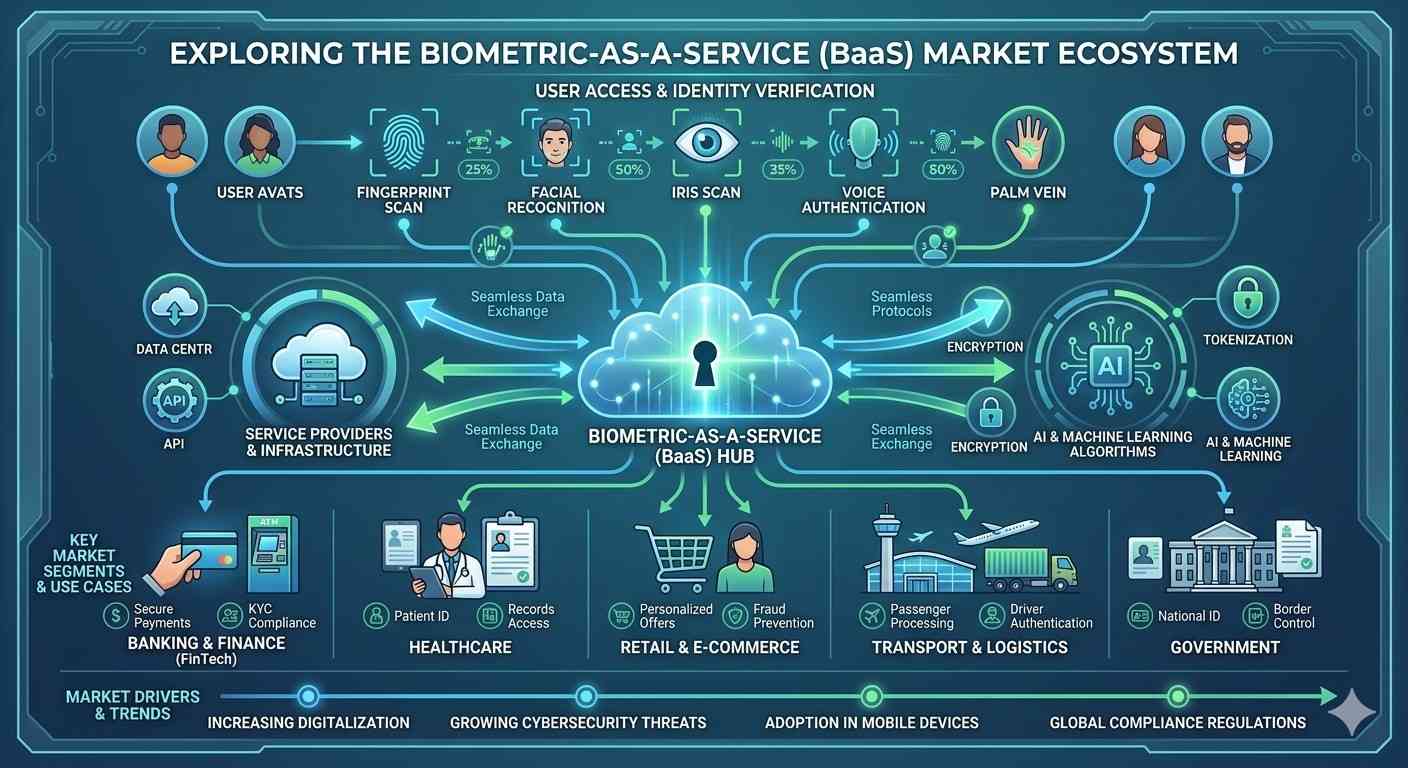
Hybrid cloud models are projected to hold a 24% share in 2026. In Germany, this is the preferred architecture as it allows organizations to store biometric data locally (on-device or on-premise) while leveraging cloud match-on-chip or API verification for scalability.
By Scanner Type: Fingerprint vs. Facial
Fingerprint recognition leads with a 32% share due to its maturity and low cost. However, Facial recognition is the fastest-growing sub-segment in the German commercial sector, driven by contactless requirements and integration into mobile banking apps.
Supply Chain Analysis (Germany Focus)
The BaaS supply chain in Germany is highly regulated and tiered:
Raw Material/Sensor Providers: Manufacturers of specialized optical and capacitive sensors (e.g., used in smartphones and scanners).
Algorithm Developers (Manufacturers): Companies like BioID (Germany) and IDEMIA who produce the software matching engines and liveness detection APIs.
Cloud Service Providers (CSPs): Platforms like Microsoft Azure or Deutsche Telekom Cloud that host the BaaS infrastructure.
System Integrators: Firms that embed biometric APIs into banking apps, airport e-gates, or government portals.
End-Users: The Bundesdruckerei (Federal Printing Office), major German banks (Deutsche Bank, Commerzbank), and healthcare providers.
“Who Supplies Whom”: Thales and IDEMIA are the primary suppliers for German border control and national ID infrastructure, while specialized firms like BioID supply the German “Mittelstand” with secure remote authentication.
Regional Analysis: Germany’s Regulatory Leadership
Within Europe, Germany acts as the regulatory benchmark. While the UK (7.5% CAGR) and France (8.0% CAGR) are significant players, Germany’s 18.4% CAGR is bolstered by the nation’s massive investment in sovereign cloud (GAIA-X) and the digitalization of the “E-Government” sector.
Competitive Landscape
The German BaaS market is moderately concentrated for government contracts but fragmented in the enterprise space.
Major Players: Thales, NEC Corporation, IDEMIA, and Fujitsu hold the lion’s share of large-scale infrastructure.
Agile Challengers: Companies like BioID (Germany) and Suprema are gaining ground in the private sector by offering specialized, high-accuracy APIs that are easier to integrate into existing SaaS stacks.
Strategic Takeaways
For Manufacturers: Focus on ISO certification and high NIST accuracy rankings. In Germany, technical validation is the only path to procurement.
For Investors: Look toward “Liveness-as-a-Service” startups. As deepfakes improve, the software that catches them becomes more valuable than the matching engine itself.
For Marketers: Emphasize “Privacy-by-Design.” German buyers prioritize how data is deleted or anonymized over the speed of the match.
Future Outlook
By 2030, Biometric-as-a-Service will move toward Decentralized Identity (DID). Users will likely hold their own biometric keys on their smartphones, with the BaaS provider acting only as a temporary “verifier” that never actually sees the raw biometric data. This “Zero-Knowledge Proof” model will be the ultimate solution to Germany’s privacy-compliance tension.
Conclusion
The German Biometric-as-a-Service market is no longer a niche security tool; it is the foundational layer of the digital economy. As the eIDAS 2.0 era begins, the convergence of high-trust BSI standards and cloud scalability offers an unprecedented incremental opportunity for vendors who prioritize security and sovereign data principles.
Why This Market Matters
Biometric-as-a-Service is the final frontier in the war against identity theft. In a world where passwords are dead and AI can mimic voices and faces, BaaS provides the only immutable link between a digital persona and a physical human being. For Germany, it is the key to unlocking a secure, fully digital future for every citizen.
Full Report: Unlock 360° insights for strategic decision making and investment planning-
https://www.factmr.com/checkout/14524
To View Related Report:
HVAC Test Instruments Market https://www.factmr.com/report/hvac-test-instruments-market
Grid-Interactive Water Heater Aggregation Software Market https://www.factmr.com/report/grid-interactive-water-heater-aggregation-software-market
Radio Frequency Duplexer Market https://www.factmr.com/report/radio-frequency-duplexer-market
RFID-Enabled Gift Boxes Market https://www.factmr.com/report/rfid-enabled-gift-boxes-market
S. N. Jha
Fact.MR
+1 628-251-1583
email us here
Legal Disclaimer:
EIN Presswire provides this news content “as is” without warranty of any kind. We do not accept any responsibility or liability
for the accuracy, content, images, videos, licenses, completeness, legality, or reliability of the information contained in this
article. If you have any complaints or copyright issues related to this article, kindly contact the author above.

Media gallery