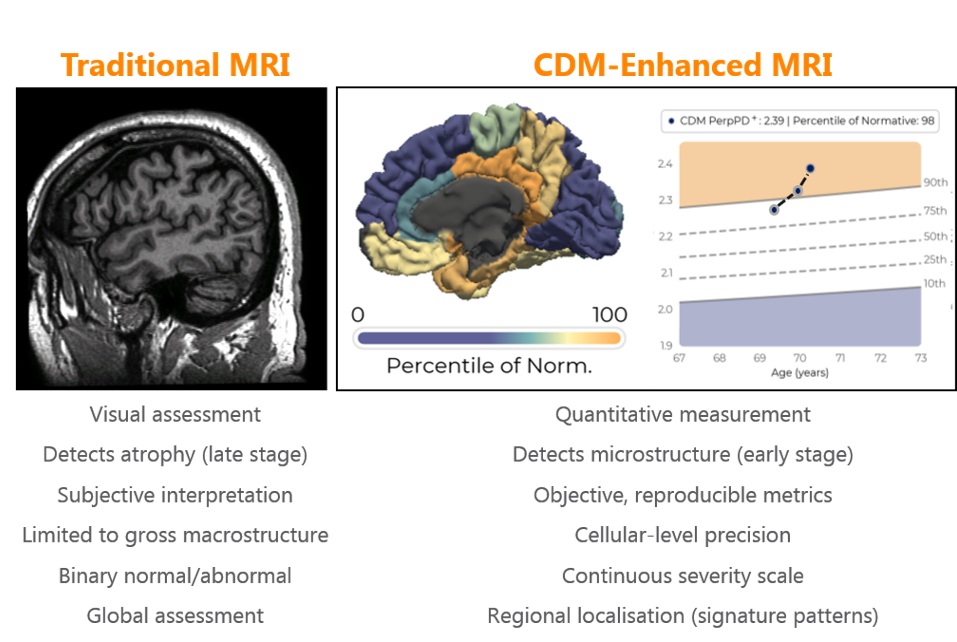
OXFORD, United Kingdom, July 13, 2026 (GLOBE NEWSWIRE) — Oxford Brain Diagnostics (OBD), a leader in MRI-based measurement of brain health and neurodegenerative disease, today announced the presentation of five new studies at the Alzheimer’s Association International Conference (AAIC) 2026. The findings further strengthen the evidence supporting OBD’s proprietary Cortical Disarray Measurement (CDM®) technology as a quantitative measure of neurodegenerative disease biology.
As disease-modifying therapies become more widely available, the field is shifting from a model centered primarily on diagnosis toward one increasingly focused on treatment selection, monitoring response, and managing disease over time. This transition requires objective, scalable ways to measure disease biology. Better measurement has the potential to help clinicians identify appropriate patients, guide therapeutic decisions, monitor disease progression, and evaluate treatment impact, enabling more personalized care while helping researchers and pharmaceutical companies develop and evaluate new therapies more effectively.
“Neurology is entering an era where measuring disease will become just as important as diagnosing it,” said Steven Chance, PhD, CEO and Founder of Oxford Brain Diagnostics. “As new therapies emerge, the field increasingly needs objective and scalable ways to identify patients, understand disease progression, and evaluate treatment impact. The studies presented at AAIC strengthen the growing evidence that MRI-derived cortical microstructure can provide quantitative insights that support more informed clinical decisions, therapeutic development, and ultimately better outcomes for patients.”
The five new studies demonstrate the potential of MRI-derived cortical microstructure to support these emerging needs across the Alzheimer’s disease continuum. Collectively, the studies build on a growing body of more than 40 scientific publications and presentations supporting MRI-derived cortical microstructure as a quantitative measure of neurodegenerative disease biology. Along with OBD’s FDA Breakthrough Device Designation, FDA 510(k)-cleared technology, and collaborations with leading academic institutions and pharmaceutical organizations, the findings further strengthen the company’s vision of establishing the quantitative foundation for measuring and managing brain health over time.
“As the field moves beyond diagnosis toward precision management of neurodegenerative disease, there is increasing need for scalable tools that can help characterize disease biology, identify appropriate patients, and monitor therapeutic impact,” said David Moss, CEO and Co-founder of INmune Bio, Inc. “Research such as this highlights the potential role of advanced MRI biomarkers in helping bridge that gap and support a more data-driven approach to patient care and therapeutic development.”
Key Studies Presented at AAIC 2026
Together, these studies demonstrate the potential of OBD’s CDM® technology to support patient identification, disease characterization, treatment monitoring, and therapeutic development in Alzheimer’s disease.
MRI Cortical Microstructure Predicts Tau Pathology Beyond Blood Biomarkers and Conventional MRI. In a study led by Ritobrato Datta, PhD, Ziad Saad, PhD and Gayle Wittenberg, PhD of Johnson & Johnson, OBD’s Cortical Disarray Measurement (CDM®) technology improved prediction of tau pathology beyond plasma pTau217 and conventional MRI measures of atrophy. The findings suggest MRI-derived cortical microstructure may provide complementary information about Alzheimer’s disease biology and support more precise patient characterization.
Independent Imaging Biomarkers Demonstrate Concordant Treatment Effects in a Phase 2 Clinical Trial. In a study by CJ Barnum, PhD, of INmune Bio, OBD’s cortical microstructure measurements demonstrated treatment-related effects that aligned with findings from an independent imaging modality in a Phase 2 Alzheimer’s disease clinical trial. The findings support the potential use of quantitative MRI biomarkers to evaluate therapeutic impact in drug development programs.
MRI Detects Signals Consistent with Slowing of Neurodegeneration During Lecanemab Treatment. Researchers led by Gerard Ridgway, PhD, of Oxford Brain Diagnostics observed evidence consistent with slowing of microstructural neurodegeneration in patients receiving lecanemab. The results highlight the potential of CDM technology as a non-invasive approach for monitoring biological response to disease-modifying therapies.
Diffusion MRI-Based Screening Model May Improve Early Identification of Alzheimer’s Disease. Research by Takashi Nakajima, MD, PhD, of Niigata National Hospital demonstrated that diffusion MRI-derived cortical microstructural features successfully distinguished Alzheimer’s disease patients from healthy controls and amyloid-negative individuals. The findings highlight the potential of advanced MRI to support earlier patient identification and stratification.
Multimodal Proteomic and Imaging Study Reinforces Biological Relevance of Cortical Microstructure. A multimodal study led by Mario Torso, PhD, of Oxford Brain Diagnostics found significant associations between cortical microstructure measurements and amyloid precursor protein (APP), a marker of neuronal integrity, across the Alzheimer’s disease continuum. The results provide additional biological validation for OBD’s MRI-derived measures of neurodegenerative disease.
The five AAIC 2026 studies expand OBD’s evidence base across biological validation, patient identification, disease characterization, treatment monitoring, and therapeutic development. Together, the findings support a future in which brain health can be measured, tracked, and acted upon more objectively throughout the patient journey, from early identification and patient stratification to treatment monitoring and long-term disease management.
To learn more about OBD, please visit www.oxfordbraindiagnostics.com
For further enquires:
Omar Ehsan, Chief Commercial Officer
omar.ehsan@oxfordbraindiagnostics.com
About Oxford Brain Diagnostics
Oxford Brain Diagnostics (OBD) is pioneering a new generation of quantitative MRI biomarkers that make brain health measurable. Built on decades of research at the University of Oxford, OBD’s proprietary platform reveals microscopic changes in brain tissue that are invisible to conventional MRI, enabling earlier detection, more precise disease measurement, and longitudinal monitoring of neurodegenerative disease. OBD’s FDA-cleared and Breakthrough Device-designated technology supports pharmaceutical companies, researchers, and healthcare providers in accelerating drug development, advancing clinical research, and delivering more personalized care. By transforming MRI into an objective measure of brain health, OBD is helping establish a new standard for the diagnosis, monitoring, and treatment of Alzheimer’s disease, Parkinson’s disease, and other neurological disorders.
A photo accompanying this announcement is available at https://www.globenewswire.com/NewsRoom/AttachmentNg/e59b0927-83e1-497f-abde-1f8fc667beb3