FOSHAN, GUANGDONG, CHINA, August 9, 2026 /EINPresswire.com/ — The landscape of professional stage production and entertainment lighting is evolving at a rapid pace, driven by higher demands for visual precision, energy efficiency, and operational reliability. When lighting designers, event producers, and rental companies seek high-performance fixtures for concert tours, theater productions, and large-scale festivals, partnering with a dependable OEM Moving Head Beam Light Manufacturer becomes a critical strategic decision. Sourcing professional-grade lighting equipment requires a thorough evaluation of manufacturing capabilities, technical specifications, and long-term partnership reliability.
As technological advancements redefine what intelligent lighting fixtures can achieve on stage, lighting equipment buyers must look beyond superficial specifications. Evaluating a manufacturing partner involves examining their research and development depth, precision production standards, thermal management innovations, and commitment to international compliance. The following core factors outline what industry professionals should analyze when selecting an experienced production partner in the current market environment.
1. Research and Development Depth and Technical Innovation
The foundation of any high-performance stage lighting fixture lies in the engineering team’s ability to innovate continuously. Modern stage environments demand sharp, concentrated beams, precise optical systems, and versatile effects that can withstand rigorous touring schedules. When reviewing potential manufacturing partners, examining their independent research and development infrastructure provides vital insight into their capability to translate complex optical requirements into reliable hardware.
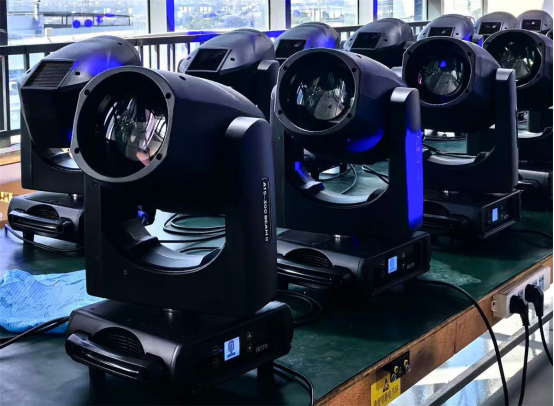
A notable example of advanced engineering in this sector is the LTS-200 Beam Professional Moving Head, which integrates a high-efficiency 150W LED module with an exceptionally tight 2-degree surgical beam. Achieving such narrow beam divergence while incorporating dual-layer prism FX features requires sophisticated optical design and precise alignment. Manufacturers who invest heavily in proprietary optical engineering and software integration are better equipped to deliver fixtures that maintain exceptional luminous intensity and color uniformity over extended operational periods.
Furthermore, technical innovation extends beyond optics into electronic control systems and firmware stability. Fixtures deployed in professional touring applications must communicate flawlessly with complex DMX, RDM, and Art-Net protocols. Evaluating a partner’s engineering milestones and patent portfolios helps buyers verify whether the production facility possesses the technical depth necessary to support customized firmware modifications and advanced lighting effects.
2. Manufacturing Infrastructure and Precision Production Standards
Engineering brilliance must be matched by rigorous manufacturing execution. The geographical concentration of industrial manufacturing infrastructure plays a significant role in determining production efficiency, component consistency, and supply chain stability. Enterprises situated in established manufacturing hubs benefit from a mature ecosystem of precision machining, electronic assembly, and raw material sourcing.
For instance, Guangdong Taisheng Entertainment Equipment Co., Ltd., operating from Shunde, Foshan, leverages a profound regional manufacturing foundation and comprehensive industrial supporting facilities. With over fifteen years of dedicated development in the stage performance lighting industry, the enterprise has cultivated deep technical accumulation and streamlined production workflows. This extensive tenure allows for refined assembly processes, automated surface-mount technology (SMT) circuit board production, and meticulous mechanical calibration.
Precision production standards ensure that every moving head fixture leaving the assembly line maintains structural integrity and thermal balance. Moving head beam lights generate intense heat within compact enclosures, making high-precision die-cast aluminum housing fabrication and intelligent thermal dissipation systems crucial. Assessing a manufacturer’s factory floor capabilities, machinery investments, and assembly line quality gates ensures that the final products can endure the mechanical stress of frequent transit and continuous operation.
3. Comprehensive Quality Control and Compliance Protocols
Reliability is the non-negotiable currency of the entertainment technology sector. A single fixture failure during a live broadcast or high-profile concert tour can result in significant operational disruption and reputational damage. Therefore, scrutinizing a manufacturer’s quality control protocols is essential before establishing a long-term OEM or ODM relationship.
Rigorous quality assurance encompasses multiple stages, beginning with raw material inspection and component aging tests. Electronic ballasts, stepper motors, LED chips, and optical glass lenses must undergo stringent stress testing under elevated temperatures and voltage fluctuations. Manufacturers committed to high standards implement multi-stage inspection procedures, including integrating sphere photometric testing to measure luminous flux, color temperature accuracy, and beam angle consistency across production batches.
In addition to internal quality benchmarks, adherence to international regulatory standards is mandatory for global distribution. Compliance certifications such as CE, RoHS, and FCC demonstrate that the lighting equipment meets stringent electromagnetic compatibility, electrical safety, and environmental protection directives. Partnering with a manufacturer that maintains transparent quality documentation and traceable production logs safeguards buyers against regulatory hurdles and ensures seamless integration into international markets.
4. Customization Flexibility and Collaborative Engineering Support
Every entertainment venue, architectural project, and touring production possesses unique requirements that off-the-shelf fixtures may not fully satisfy. Whether modifying DMX channel profiles, adjusting pan and tilt speed parameters, or integrating custom branding and exterior housing colors, an ideal manufacturing partner must offer robust customization flexibility.
Effective collaboration between the client and the engineering team transforms conceptual ideas into market-ready products. This collaborative process involves reviewing initial architectural drawings, prototyping optical assemblies, and conducting iterative testing to validate performance metrics. Manufacturers with dedicated technical support teams can provide comprehensive OEM and ODM services, accommodating specific voltage requirements, hanging bracket configurations, and specialized control protocols.
Evaluating past project collaborations and custom development case studies offers clear visibility into how responsive a manufacturer is during the design iteration phase. A transparent communication channel, paired with responsive engineering feedback, ensures that custom lighting solutions align precisely with project timelines and artistic visions without compromising structural or electrical integrity.
5. Supply Chain Resilience and Long-Term Partnership Reliability
The ability to scale production and deliver orders within agreed timelines is a vital test of operational maturity. Global supply chain fluctuations can disrupt component availability, making supply chain resilience and strategic inventory management critical attributes of a dependable manufacturing partner.
Established enterprises maintain diversified sourcing networks for critical components, reducing vulnerability to single-source bottlenecks. Furthermore, efficient logistics coordination ensures that shipments are securely packaged and dispatched with appropriate documentation for international freight. Long-term partnership reliability also involves responsive after-sales support, including readily available replacement parts, comprehensive technical manuals, and warranty backing that reassures buyers of the manufacturer’s commitment to sustained product performance.
Evaluating a partner’s market reputation, customer retention rates, and historical stability helps event organizers and equipment distributors build secure, mutually beneficial supply relationships. Selecting a production facility that prioritizes steady, sustainable growth over short-term volume guarantees a reliable foundation for future technological upgrades and fleet expansions.
Navigating the complexities of professional stage lighting procurement requires careful balancing of technical innovation, manufacturing precision, and quality assurance. By systematically assessing these core operational dimensions, industry professionals can forge productive partnerships that elevate stage performance standards. Exploring comprehensive product portfolios and manufacturing capabilities provides deeper insights into modern professional lighting solutions; further details can be found directly at https://www.antslighting.com/
Guangdong Taisheng Entertainment Equipment Co., Ltd.
Guangdong Taisheng Entertainment Equipment Co., Ltd.
email us here
Legal Disclaimer:
EIN Presswire provides this news content “as is” without warranty of any kind. We do not accept any responsibility or liability
for the accuracy, content, images, videos, licenses, completeness, legality, or reliability of the information contained in this
article. If you have any complaints or copyright issues related to this article, kindly contact the author above.

Media gallery