The Business Research Company’s Space On-board Computing Platform Global Market Report 2026 – Market Size, Trends, And Forecast 2026-2035
LONDON, GREATER LONDON, UNITED KINGDOM, October 26, 2026 /EINPresswire.com/ — The space on-board computing platform market is emerging as a critical component within the broader aerospace and information technology sectors. As satellite missions and space exploration efforts accelerate, the industry is poised for significant growth driven by technological advancements and expanding applications. This overview explores the market size, regional dynamics, key drivers, technological trends, and major players shaping the future of space on-board computing.
Market Size and Its Position Within the Larger High Performance Computing Landscape
The space on-board computing platform market is set to exceed $3 billion by 2030. When compared to its parent segment, the High Performance Computing market, which is predicted to reach around $91 billion by the same year, the space on-board computing platforms will make up approximately 3% of that total. Within the vast Information Technology industry, expected to hit $13,788 billion by 2030, this specialized market will represent a modest yet significant 0.02% share.
Request A Free Sample Of The Space On-board Computing Platform Market Report
https://thebusinessresearchcompany.com/sample_request?id=72814109&type=smp&name=Space%20On-board%20Computing%20Platform%20Market%20Report%202026&utm_source=EINPresswire&utm_medium=Paid&utm_campaign=Oct_PR
North America Emerges as the Leading Region in Space On-board Computing by 2030
By 2030, North America is projected to be the dominant region in the space on-board computing platform market, with a valuation of $1.0 billion. The market there is anticipated to grow from $0.6 billion in 2025 at a CAGR of 11%. This expansion is largely driven by the deployment of advanced satellite constellations focused on Earth observation and communications. Additionally, increased demand for high-performance onboard processing to support real-time decisions during space missions, substantial investments in commercial space ventures, and the adoption of radiation-hardened and AI-enabled computing systems contribute to this growth. The region’s focus on deep space exploration and defense-related projects, coupled with continuous innovations in edge computing for harsh space conditions, further cements North America’s leadership.
The United States Poised to Dominate as the Largest Country Market in 2030
The United States will hold the largest country-specific market share within the space on-board computing platform segment, expected to reach $0.8 billion by 2030. Growing from $0.5 billion in 2025 at an 11% CAGR, the US market benefits from the deployment of next-generation satellites and spacecraft programs. Increased demand for autonomous navigation and onboard decision-making tools, along with rising investments in military space situational awareness, underpin this growth. Private sector involvement in developing advanced computing payloads, edge AI processing technologies, and modernization of space-grade electronics and avionics all support the country’s market expansion.
Access The Detailed Space On-board Computing Platform Market Report Here
https://thebusinessresearchcompany.com/report/space-on-board-computing-platform-global-market-report?utm_source=EINPresswire&utm_medium=Paid&utm_campaign=Oct_PR
Small Satellites to Lead Platform Segments in Space On-board Computing Market
Within the space on-board computing platform market, segmentation by platform shows small satellites as the largest segment, accounting for 33% of the total market — roughly $1 billion by 2030. This dominance is fueled by the rising deployment of compact, cost-effective satellite constellations aimed at global connectivity and Earth observation. The demand for rapid-deployment space systems serving commercial and defense needs, alongside the integration of miniaturized onboard computing units for real-time data analysis, keeps this segment growing. Expansion of low Earth orbit (LEO) satellite networks by private companies and improvements in lightweight, power-efficient electronics also contribute to the segment’s strength. Modular satellite designs, which enable scalable and flexible missions, further enhance growth prospects.
Overview of Technology, Orbit, Communication, and Application Segments
The market is classified by technology into commercial off-the-shelf (COTS) and non-COTS components. Orbit-wise, it includes low Earth orbit (LEO), medium Earth orbit (MEO), and geostationary Earth orbit (GEO) segments. Communication frequency-wise, the market covers s-band, x-band, c-band, k-band, and other frequencies. Application areas span communication, Earth observation, navigation, meteorology, and additional specialized uses.
Consistent 11% CAGR Expected Through 2030
The space on-board computing platform market is forecasted to maintain a strong compound annual growth rate of 11% leading up to 2030, underpinned by a range of expanding applications and increasing demand for advanced processing capabilities in space systems.
Growth Propelled by Rising Earth Observation and Mapping Needs
One of the key factors boosting market growth is the surging demand for Earth observation and mapping applications. Accurate geospatial intelligence, environmental monitoring, and terrain mapping are more crucial than ever. Governments, defense agencies, and commercial operators are investing heavily in satellite missions that improve disaster management, urban development, and resource tracking. Space on-board computing platforms play an essential role in collecting and processing large volumes of satellite data in orbit. The growing reliance on real-time navigation and mapping services across transportation, agriculture, and logistics sectors further accelerates the adoption of advanced spacecraft avionics, contributing to an estimated 2.7% annual market growth.
Expansion of Satellite Communication and Navigation Accelerates Market Development
Another significant driver is the rapid expansion of satellite-based communication and navigation services. Satellite operators increasingly require efficient on-board systems to manage continuous data handling and transmission. The growing use of satellite navigation in aviation, maritime, defense, and commercial transport sectors demands reliable onboard computing infrastructure. Advanced avionics systems improve mission accuracy, communication efficiency, and positioning reliability. Investments in global navigation satellite systems and communication constellations continue to rise, supporting roughly 2.5% annual growth in the market.
Government and Defense Space Programs Boost Demand for Advanced Computing
Government and defense initiatives are also key contributors to market expansion. Increased funding for national security, surveillance, and strategic satellite missions is driving demand for high-performance onboard data processing. Defense agencies deploy satellites for intelligence gathering, border monitoring, and secure communications—operations that depend on robust onboard computing capabilities. Meanwhile, government space agencies expand exploration and Earth observation programs to reinforce scientific research and infrastructure development. The increasing number of public sector satellite launches fuels demand for advanced avionics systems that can manage critical mission functions, contributing to about 2.2% annual market growth.
Opportunities Across Satellite Sizes and Spacecraft Segments
The nano satellite, microsatellite, small satellite, medium satellite, large satellite, and spacecraft segments collectively represent the most promising growth areas. By 2030, these combined sectors are expected to generate over $1.2 billion in value. Drivers include the deployment of multi-orbit satellite architectures, increased demand for reliable onboard computing capable of autonomous operation, and growing use of satellites for climate monitoring and disaster prediction. Advances in radiation-tolerant hardware, fault-resilient designs, and AI-enabled analytics onboard spacecraft support mission-critical decision-making. These trends underscore an industry-wide push toward enhancing mission autonomy, improving real-time data processing, and enabling next-generation space exploration and commercial satellite services.
Projected Growth Breakdown by Satellite Type From 2025 to 2030
Over the next five years, the nano satellite market is forecast to increase by $0.2 billion, the microsatellite segment by $0.2 billion, small satellites by $0.4 billion, medium satellites by $0.2 billion, large satellites by $0.1 billion, and the spacecraft segment by $0.1 billion. This expansion reflects a balanced growth across various platform sizes and types.
Industry Focus on High-Performance and Resilient Space Computing Solutions
The space on-board computing platform market is driven by global aerospace electronics manufacturers and specialized space technology firms. These companies concentrate on developing radiation-hardened processors, fault-tolerant architectures, real-time data processing systems, and mission-critical avionics software to ensure reliability in extreme space environments. Emphasis on miniaturization, energy efficiency, autonomous decision-making, and cybersecurity shapes product innovation. For stakeholders, understanding the competitive landscape is vital to seize growth opportunities, foster technological advancements, and forge strategic partnerships in this rapidly evolving sector.
BAE Systems plc Leads the Market with Significant Share
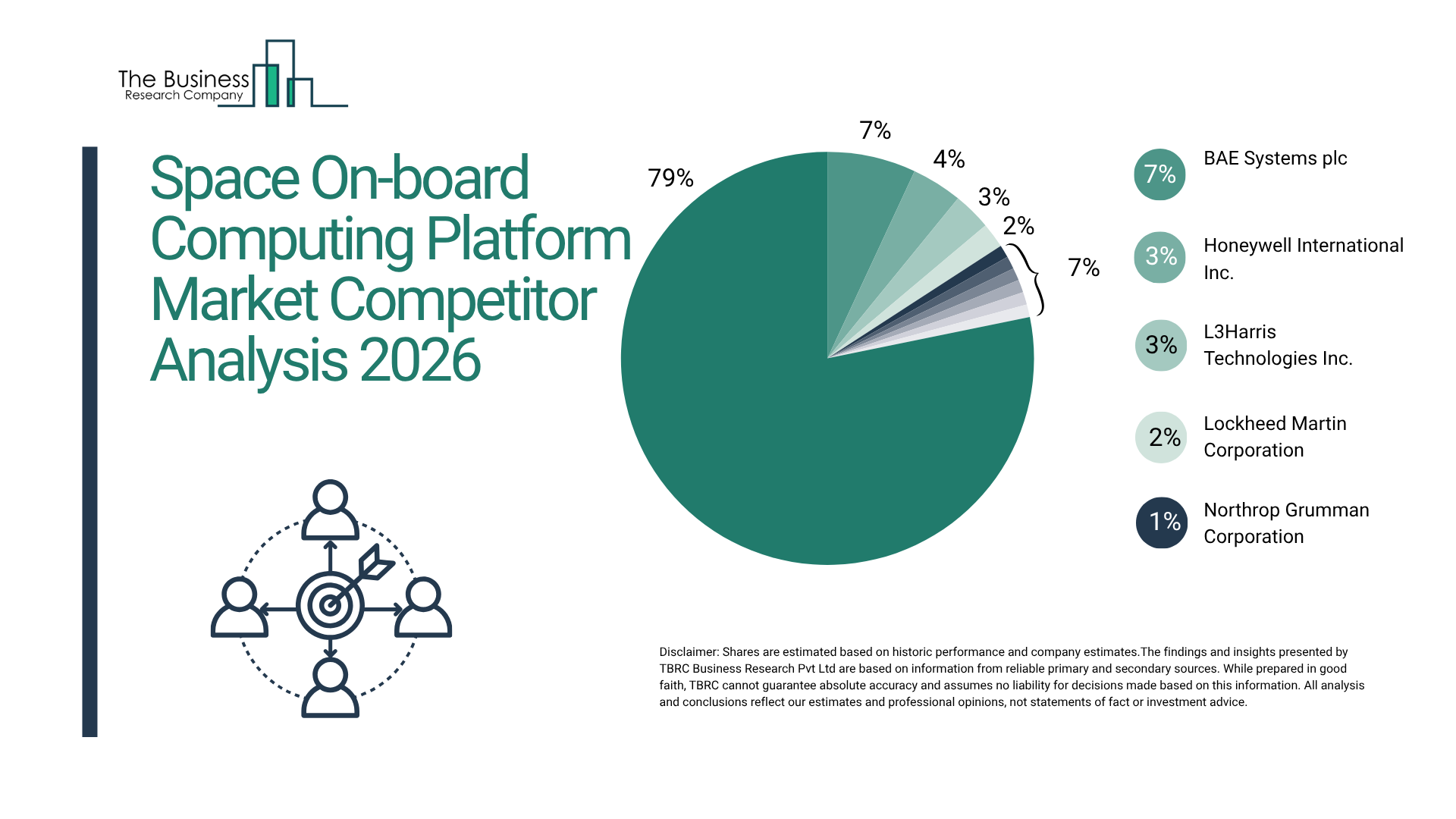
BAE Systems plc stands out as the leading company, controlling a 7% share of the global space on-board computing platform market in 2025. Its space electronics and mission computing division offers a broad portfolio of radiation-hardened onboard computers, avionics processing units, fault-tolerant computing systems, and mission-critical software, supporting satellites, spacecraft, and deep space exploration efforts.
Key Players Driving the Space On-board Computing Platform Industry
Other major contributors in the market include Honeywell International Inc., L3Harris Technologies Inc., Lockheed Martin Corporation, Northrop Grumman Corporation, Airbus SE, Maxar Technologies, The Boeing Company, Thales Group, and Raytheon Technologies Corporation. These firms hold diverse aerospace electronics portfolios, maintain strong ties with defense and space agencies, and operate global manufacturing and integration networks. Continuous innovation in onboard computing hardware and avionics systems has enabled them to sustain and grow their market positions.
Market Structure Reflects Moderate Fragmentation with Top Players Holding Significant Shares
The market shows a moderate level of fragmentation, with the leading 10 companies accounting for 21% of total revenue in 2025. Entry barriers stem from rigorous space-grade certifications, radiation-hardening requirements, complex integration demands, and the critical need for reliability and fault tolerance in space operations. The top players’ combined expertise and innovation capacity position them to capitalize on rising demand for radiation-hardened processors, autonomous spacecraft computing, edge AI onboard systems, and reliable mission computing architectures.
Major Raw Material Suppliers Supporting the Space On-board Computing Ecosystem
Key raw material and component suppliers include industry giants such as Northrop Grumman Corporation, Lockheed Martin Corporation, The Boeing Company, Airbus SE, Thales Group, RTX Corporation, BAE Systems plc, Leonardo S.p.A., L3Harris Technologies Inc., Honeywell International Inc., Teledyne Technologies Incorporated, Safran S.A., Mitsubishi Electric Corporation, Mitsubishi Heavy Industries Ltd., OHB SE, Sierra Nevada Corporation, Maxar Technologies Inc., Ball Corporation, STMicroelectronics N.V., Texas Instruments Incorporated, Intel Corporation, NVIDIA Corporation, AMD, Microchip Technology Incorporated, and Analog Devices Inc.
Wholesale and Distribution Networks in the Space On-board Computing Platform Market
The market’s supply chain includes leading wholesalers and distributors such as Avnet Inc., Arrow Electronics Inc., Ingram Micro Inc., Tech Data Corporation, Synnex Corporation, Future Electronics Inc., Mouser Electronics Inc., Digi-Key Electronics, RS Group plc, Farnell Global Trading Limited, TTI Inc., Avio S.p.A. Distribution Services, Collins Aerospace Logistics, Macnica Inc., Westcon Group, Exclusive Networks SA, Bechtle AG, ALSO Holding AG, and Redington Limited.
Key End Users Driving Demand Across Governments and Private Space Companies
Major end users encompass prominent government organizations and private companies including NASA, European Space Agency, Indian Space Research Organisation, Japan Aerospace Exploration Agency, China National Space Administration, Roscosmos, SpaceX, Blue Origin LLC, OneWeb Satellites, Planet Labs PBC, Spire Global Inc., SES S.A., Inmarsat Global Limited, Eutelsat Communications S.A., Sierra Space Corporation, Relativity Space Inc., Rocket Lab USA Inc., and Indian National Satellite System Operators.
Competitive Market Trends Fueled by Strategic Collaborations and Advanced Technologies
Strategic partnerships are reshaping the space on-board computing platform industry by enhancing edge computing capabilities, improving real-time data processing, and advancing AI applications in orbit. For example, in April 2024, Firefly Aerospace joined forces with Klepsydra Technologies to deploy AI-powered applications on the Elytra edge computing platform aboard the Alpha rocket mission. This collaboration enables on-orbit real-time data processing, AI navigation model experimentation, and dynamic switching of applications to optimize attitude determination, guidance, and control systems during space operations.
Corporate Strategies Focused on Innovation to Maintain Market Leadership
Leading companies are focusing on advancing space on-board computing platforms to enhance real-time processing and autonomy. They are leveraging edge computing architectures to improve payload efficiency and communication performance, expanding avionics infrastructure to increase observation accuracy and mission reliability, and integrating AI systems for smarter onboard decision-making and optimization. These strategies aim to keep pace with rapid technological evolution and growing mission complexity in the space sector.
The 2026 edition of our market reports now delivers enhanced analytical coverage through market attractiveness scoring and analysis, total addressable market (TAM) analysis, company scoring matrix graphics and tables, Excel-based forecasting dashboards, market hotspots infographics, key technologies and future trend analysis, plus updated graphics and tables.
Learn More About The Business Research Company
The Business Research Company (www.thebusinessresearchcompany.com) is a leading market intelligence firm renowned for its expertise in company, market, and consumer research. We have published over 30,000+ reports across 27 industries and 60+ geographies. Our research is powered by 1,500,000 datasets, extensive secondary research, and exclusive insights from interviews with industry leaders.
We provide continuous and custom research services, offering a range of specialized packages tailored to your needs, including Market Entry Research Package, Competitor Tracking Package, Supplier & Distributor Package and much more.
Disclaimer: Please note that the findings, conclusions and recommendations that TBRC Business Research Pvt Ltd delivers are based on information gathered in good faith from both primary and secondary sources, whose accuracy we are not always in a position to guarantee. As such TBRC Business Research Pvt Ltd can accept no liability whatever for actions taken based on any information that may subsequently prove to be incorrect. Analysis and findings included in TBRC reports and presentations are our estimates, opinions and are not intended as statements of fact or investment guidance.
Contact Us:
The Business Research Company
Americas +1 310-496-7795
Europe +44 7882 955267
Asia & Others +44 7882 955267 & +91 8897263534
Email: marketing@tbrc.info
Follow Us On:
LinkedIn: https://in.linkedin.com/company/the-business-research-company
Oliver Guirdham
The Business Research Company
info@tbrc.info
+44 7882 955267
Visit us on social media:
LinkedIn
Facebook
X
Legal Disclaimer:
EIN Presswire provides this news content “as is” without warranty of any kind. We do not accept any responsibility or liability
for the accuracy, content, images, videos, licenses, completeness, legality, or reliability of the information contained in this
article. If you have any complaints or copyright issues related to this article, kindly contact the author above.

Media gallery